WPA3 Standard Officially Launches With New Wi-Fi Security Features

The Wi-Fi Alliance today officially launched

WPA3

—the next-generation Wi-Fi security standard that promises to eliminate all the known security vulnerabilities and wireless attacks that are up today including the dangerous

KRACK attacks

.

WPA, or Wi-Fi Protected Access, is a standard designed to authenticate wireless devices using the Advanced Encryption Standard (AES) protocol and is intended to prevent hackers from eavesdropping on your wireless data.

However, in late last year, security researchers uncovered a severe flaw in the current WPA2 protocol, dubbed

KRACK

(Key Reinstallation Attack), that made it possible for attackers to intercept, decrypt and even manipulate WiFi network traffic.

Although most device manufacturers patched their devices against KRACK attacks, the WiFi Alliance, without much delay, rushed to finalize and launch WPA3 in order to address WPA2’s technical shortcomings from the ground.

What is WPA3? What New Security Features WPA3 Offers?

WPA3 security standard

will replace the existing WPA2 that has been around for at least 15 years and widely used by billions of devices every day.

The new security protocol provides some big improvements for Wi-Fi enabled devices in terms of configuration, authentication, and encryption enhancements, making it harder for hackers to hack your Wi-Fi or eavesdrop on your network.

On Monday, the Wi-Fi Alliance launched two flavors of latest security protocol—WPA3-Personal and WPA3-Enterprise—for personal, enterprise, and IoT wireless networks.

Here are some key features provided by the new protocol:

1.) Protection Against Brute-Force Attacks

WPA3 provides enhanced protection against offline brute-force dictionary attacks, making it harder for hackers to crack your WiFi password—even if you choose less complex passwords—by using commonly used passwords over and over again.

2.) WPA3 Forward Secrecy

WPA3 leverages SAE (Simultaneous Authentication of Equals) handshake to offer forward secrecy, a security feature that prevents attackers from decrypting old captured traffic even if they ever learn the password of a network.

3.) Protecting Public/Open Wi-Fi Networks

WPA3 strengthens user privacy in open networks through individualized data encryption, a feature that encrypts the wireless traffic between your device and the Wi-Fi access point to mitigate the risk of Man-in-the-Middle (MitM) attacks. To prevent such passive attacks, WPA3 could add support for Opportunistic Wireless Encryption (OWE).

4.) Strong Encryption for Critical Networks

Using WPA3 Enterprise, critical Wi-Fi networks handling sensitive information (such as government, , and industrial organizations), can protect their Wi-Fi connections with 192-bit encryption.

Wi-Fi Easy Connect

Alongside WPA3, the WiFi Alliance has also

announced

a new feature, called

Wi-Fi Easy Connect

, that simplifies the process of pairing smart home gadgets (without any screen or display) to your router.

Wi-Fi Easy Connect is a replacement for Wi-Fi Protected Setup (WPS), which has been considered insecure.

With the support for Easy Connect, you will be able to pair your smart gadget with the router by simply scanning a QR code with your smartphone to have the Wi-Fi credentials automatically sent to the new smart device.

It should be noted that both WPA3 and Wi-Fi Easy Connect will not hit the mainstream right away. In fact, it is going to be a many-years-long process that will require new routers and smart gadgets to support WPA3.

Therefore, WPA2 will not stop working any time soon, and devices with WPA3 support will still be able to connect with devices that use WPA2 for the working of your gadgets, but WPA3 support will eventually become mandatory as adoption grows.

WPA3 is set to roll out later this year and is expected to hit mass adoption in late 2019, when it eventually become a requirement for devices to be considered Wi-Fi certified, according to the WiFi Alliance.

Read the Full Article here: >The Hacker News [ THN ]

Thousands of Mobile Apps Expose Their Unprotected Firebase Hosted Databases

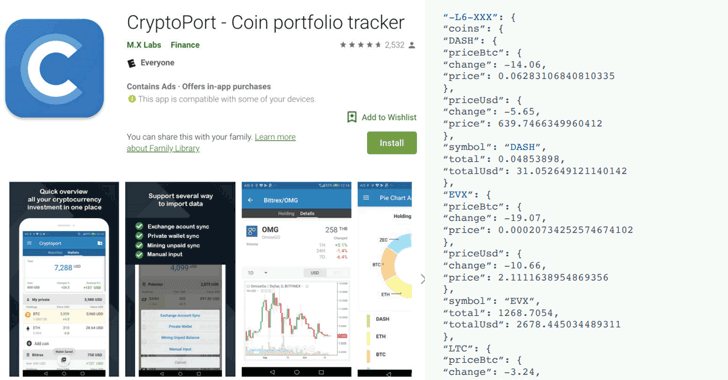
Mobile security researchers have discovered unprotected Firebase databases of thousands of iOS and Android mobile applications that are exposing over 100 million data records, including plain text passwords, user IDs, location, and in some cases, financial records such as banking and cryptocurrency transactions.

Google’s Firebase service is one of the most popular back-end development platforms for mobile and web applications that offers developers a cloud-based database, which stores data in JSON format and synced it in the real-time with all connected clients.

Researchers from mobile security firm Appthority discovered that many app developers’ fail to properly secure their back-end Firebase endpoints with firewalls and authentication, leaving hundreds of gigabytes of sensitive data of their customers publicly accessible to anyone.

Since Firebase offers app developers an API server, as shown below, to access their databases hosted with the service, attackers can gain access to unprotected data by just adding “/.json” with a blank database name at the end of the hostname.

Sample API URL:

https://<Firebase project name>.firebaseio.com/<database.json>

Payload to Access: 

Data https://<Firebase project name>.firebaseio.com/.json

To find the extent of this issue, researchers scanned over 2.7 million apps and found that more than 3,000 apps—2,446 Android and 600 iOS apps—were leaking a whole 2,300 databases with more than 100 million records, making it a giant breach of over 113 gigabytes of data.

The vulnerable Android apps alone were downloaded more than 620 million times.

Affected apps belong to multiple categories such as telecommunication, cryptocurrency, finance, postal services, ride-sharing companies, educational institutions, hotels, productivity, health, fitness, tools and more.

Researchers also provided a brief analysis, given below, of the obtained data they had downloaded from vulnerable applications.

  • 2.6 million plaintext passwords and user IDs
  • 4 million+ PHI (Protected Health Information) records (chat messages and prescription details)
  • 25 million GPS location records
  • 50,000 financial records including banking, payment and Bitcoin transactions
  • 4.5 million+ Facebook, LinkedIn, Firebase, and corporate data store user tokens.

All this is happening at the first place because Google Firebase service does not secure user data by default, requiring developers to explicitly implement

user authentication

on all database rows and tables to protect their databases from unauthorized access.

“The only security feature available to developers is authentication and rule-based authorization,” the researchers explain. What’s worse? There are no “third-party tools available to provide encryption for it.”

Researchers claimed they had already contacted Google and provided a list of all vulnerable app databases, and also contacted a few app developers helping them to patch this issue.

Read the Full Article here: >The Hacker News [ THN ]

Android Gets New Anti-Spoofing Feature to Make Biometric Authentication Secure

Google just announced its plan to introduce a new anti-spoofing feature for its Android operating system that makes its biometric authentication mechanisms more secure than ever.

Biometric authentications, like the fingerprint, IRIS, or face recognition technologies, smoothen the process of unlocking devices and applications by making it notably faster and secure.

Although biometric systems also have some pitfalls that are not hidden from anyone, as it has been proven multiple times in the past that most biometric scanners are vulnerable to spoofing attacks, and in most cases fooling them is quite easy.

Google announced today a better model to improve biometric security, which will be available from Android P, allowing mobile app developers to integrate an enhanced mechanism within their apps to keep users’ data safe.

New Biometric Metrics to Identify Spoofing and Imposter Attacks

Currently, the Android biometric authentication system uses two metrics—False Accept Rate (FAR) and False Reject Rate (FRR)—in combination with machine learning techniques to measure accuracy and precision of the user’s input.

In brief, ‘False Accept Rate’ defines how often the biometric model accidentally classifies an incorrect input as belonging to the targeted user, while ‘False Reject Rate’ records how often a biometric model accidentally classifies the user’s biometric as incorrect.

However, Google says none of the given metrics is capable enough to precisely identify if biometric data entered by a user is an attempt by an attacker to make unauthorized access using any spoofing or impostor attack.

In an attempt to resolve this issue, in addition to FAR and FRR, Google has now introduced two new metrics—Spoof Accept Rate (SAR) and Imposter Accept Rate (IAR)—that explicitly account for an attacker in the threat model.

“As their names suggest, these metrics measure how easily an attacker can bypass a biometric authentication scheme,” Vishwath Mohan, a security engineer with Google Android team, says.

“Spoofing refers to the use of a known-good recording (e.g., replaying a voice recording or using a face or fingerprint picture), while impostor acceptance means a successful mimicking of another user’s biometric (e.g., trying to sound or look like a target user).”

Google to Enforce Strong Biometric Authentication Policies

Based upon user’s biometric input, the values of SAR/IAR metrics define if it is a “strong biometric” (for values lower than or equal to 7%), or a “weak biometric” authentication (for values higher than 7%).

While unlocking your device or an application, if these values fall under weak biometric, Android P will enforce strict authentication policies on users, as given below:

  • It will prompt the user to re-enter their primary PIN, pattern, password or a strong biometric if the device is inactive for at least 4 hours (such as when left at a desk or charging).
  • In case, you left your device unattended for 72-hours, the system will enforce policy mentioned above for both weak and strong biometrics.
  • For additional safety, users authenticated with weak biometric would not be able to make payments or participate in other transactions that involve a KeyStore auth-bound key.

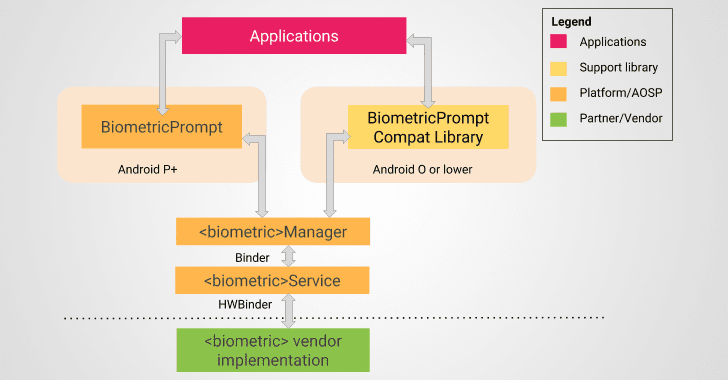
Besides this, Google will also offer a new easy-to-use BiometricPrompt API that developers can use to set up a robust authentication mechanism in their apps to ensure maximum security of their users by completely blocking weak biometric authentication detected by two newly added metrics.

“BiometricPrompt only exposes strong modalities, so developers can be assured of a consistent level of security across all devices their application runs on,” Mohan said.

“A support library is also provided for devices running Android O and earlier, allowing applications to utilize the advantages of this API across more devices.”

The new feature would positively prevent unauthorized access to devices from thieves, spies and law enforcement agencies as well by locking it down to cripple known methods to bypass biometric scanners.

Read the Full Article here: >The Hacker News [ THN ]

Shipping Industry Cybersecurity: A Shipwreck Waiting to Happen

The global shipping industry is vulnerable to a range of hacks, including one that can send multi-million dollar vessels on a collision course for disaster, according researchers. Worse, the flaws are trivial to execute and easy to mitigate against, according to a report by Pen Test Partners.

“Ship security is in its infancy – most of these types of issues were fixed years ago in mainstream IT systems,” said Pen Test Partners researcher Ken Munro, in a report on the findings released this week. “The advent of always-on satellite connections has exposed shipping to hacking attacks. Vessel owners and operators need to address these issues quickly, or more shipping security incidents will occur. What we’ve only seen in the movies will quickly become reality.”

As part of its report, Pen Test Partners also released a number of proof-of-concept (PoC) attacks where it demonstrated multiple techniques for disrupting the shipboard navigation systems. “We’ve broken new ground by linking satcom terminal version details to live GPS position data,” according to the report.

Munro said that the PoC flaws are the tip of the iceberg. Many more worse issues were uncovered. He said other bugs would be shared privately with vendors.

Forcing Ships Off-Course

In one of the PoCs shared in the report, researchers noted that the electronic charts that are used to navigate, called Electronic Chart Display and Information System (ECDIS), are a ripe target for hackers. They said the ECDIS is not difficult to hack and manipulate once an attacker breaches the vessel’s network. And that’s fairly simple to achieve because of an abundance of outdated OS and poorly protected configuration interfaces, researchers said.

“We tested over 20 different ECDIS units and found all sorts of crazy security flaws,” Munro said. “Most ran old operating systems, including one popular in the military that still runs Windows NT.”

As hackable as it is, all too often, the ECDIS is left in charge of steering the ship, researchers said.

“[ECDIS] can slave directly to the autopilot – most modern vessels are in ‘track control’ mode most of the time, where they follow the ECDIS course,” Munro explained. “Hack the ECDIS and you may be able to crash the ship, particularly in fog. Younger crews get ‘screen-fixated’ all too often, believing the electronic screens instead of looking out of the window.”

In one PoC example, once an adversary gained access to the shipboard IT infrastructure, a hacker could fool the ECDIS into thinking that the GPS receiver was in a different location on board. That would effectively spoof the ship’s navigational systems to believe the ship was in a different place on the water. The system could then automatically “correct” the course, thus sending the ship off into the wrong direction.

The team was also able to expand the perceived GPS footprint to make the ECDIS think the ship was a kilometer wide, wreaking havoc with anti-collision systems. The AIS transceiver, responsible for collision alerts, uses ECDIS data to not only send out the ship’s location to other vessels if there’s a perceived danger, but also for receiving the same data back. By tricking the system into thinking a collision is imminent, other ships could alter their own courses, jamming up shipping lanes.

“Other ships’ AIS will alert the ship’s captain to a collision scenario,” Hunt said. “It would be a brave captain indeed to continue down a busy, narrow shipping lane whilst the collision alarms are sounding.”

The implications here are profound: “Block the English Channel and you may start to affect our supply chain,” Hunt added.

The researchers also found that it’s possible to hack the systems used to control the steering gear, engines, ballast pumps and more. These communicate using NMEA 0183 messages, which are sent in plaintext, with no message authentication, encryption or validation.

“All we need to do is man-in-the-middle and modify the data,” Hunt said. “This isn’t GPS-spoofing, which is well known and easy to detect, this is injecting small errors to slowly and insidiously force a ship off course.”

Real-World Implications

Barry Greene, principal architect at Akamai, said that a range of actors could make very good use of these kinds of attacks.

“It can be used (and most likely is being used) to track state intelligence interest,” he told Threatpost. “Criminal threat actors would look for ways to ‘monetize.’ If there is money, they will find a way to exploit. Corporate intelligence threat actors would (and most likely are) using these exploits to track competition. Activist threat actors would use it to track illegal shipping: banned animal products, weapons and human trafficking.”

He added that there are other, less obvious consequences.

“The ugly part is logical consequences that are not being considered,” he told us. “Think about the current pirate situation in several parts of the world. These pirates can use this information for their intelligence. What would be the response when someone gets killed in the Straits of Malacca by pirates who are using these exploits to target their hits?”

Further illustrating the real-world implications, Pen Test Partners has managed to link version details for ships’ satcom terminals to live GPS position data, to establish a clickable map where vulnerable ships can be highlighted with their real-time position (it’s not updated however, thus ensuring it remains out of date and useless to hackers).

All Back to Password Hygiene

In order to carry any of the above attack scenarios out, threat actors would need to gain access to the vessel networks in the first place. Unfortunately, that proves to be fair simple as well, given that satcom terminals on ships are available on the public internet. Many have default credentials, Hunt explained, admin/1234 being the most common. And failing to set a strong administrative password opens the door to a raft of security issues.

“It’s an easy way to hijack the satellite communications and take admin rights on the terminal on board,” explained Munro.

Looking into a Cobham (Thrane & Thrane) Fleet One satellite terminal, Munro found a number of exploitable flaws. For starters, the admin interfaces communicate via insecure telnet and HTTP. They also lack firmware signing, making it possible to edit the entire web application running on the terminal. There is also no rollback protection for the firmware, so a hacker could elevate privilege by installing an older, more vulnerable firmware version. Lastly, the administrator interface passwords are embedded in the configurations, hashed with unsalted MD5.

All of these flaws (again, easily fixed with a strong password) offer routes into the vessel’s network; and, thanks to a general lack of network segregation on board most ships, attackers can likely easily pivot to the navigation system, Munro pointed out.

Mitigation

Like all sectors, getting serious about the risk to their industry should be on the to-do list of vendors and shipping companies alike. However, that’s easier said than done.

“Hopefully, these findings will encourage action, but the reality is that most people who need to know about this risk within the shipping/container/port industry may not hear about this report,” said Greene. “They live in their own specialized community…There is a whole industry built around the shipping industry who never thinks about security. They are thinking, ‘how do I build this function to manage the container lift during the time it is pulling the container off the ship.’”

A good place to start, he added, is for shipping companies to pull in vendors for meaningful security conversations. “Their security interest would wake up the vendor to put security on the top of their list,” Greene explained, adding that shipping companies should make use of their existing resources.

“Their number one security talent is the specialist within their organizations,” he said. “They know their industry. They know their business. CxOs should take those teams, pull them off to the side for a couple of days and have them ‘think like hackers.’ They will come back with a list of security priorities that would be better tuned to the shipping/container/port industry.”

Read the Full Article here: >threatpost – The First Stop for Security News

Hacker takes down Copenhagen’s bike-hire network and deletes database

Copenhagen’s bike network was rendered useless in a cyber attack over the weekend in which the hacker was able to completely wipe the network’s database. Officials claim that the attack happened some time between 4 May and 5 May, and meant that people were not able to hire bikes from the Bycyklen system – similar to London’s ‘Santander Hire’ bike hire system, except that the bikes have built-in electric motors.

Read the Full Article here: >Computer Security News

FBI: Cyber-Fraud Losses Rise to Reach $1.4B

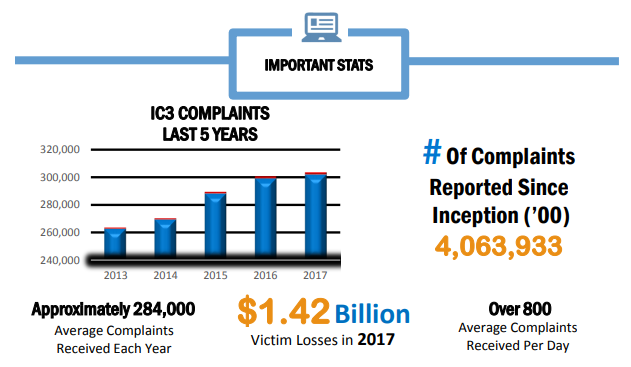
About 301,580 consumers reported cyber-fraud and malware attacks to the FBI’s Internet Crime Complaint Center (IC3) last year – with reported losses exceeding a whopping $1.4 billion.

The year’s haul of reports brings the overall total of complaints since the IC3 began recording such things to 4 million.

Top threats for the year include well-worn trends like whaling, phishing and ransomware, but also tech support fraud, confidence games involving romance themes, non-payment scams and also straightforward extortion.

Notable Stats

Whaling, a.k.a. business email compromise, made up the bulk of the complaints for the department, with 15,690 individuals affected and accounting for adjusted losses of more than $675 million. In these cases, criminals masquerade as company executives to request a change in account information for wire transfers in order to siphon off money to their own accounts, or to request for personally identifiable information or W-2 form data for employees. In 2017, the real estate sector was in particular heavily targeted, IC3 said.

Tech-support fraud, where criminals pose as a variety of different security, customer or technical support reps offering to resolve any number of (non-existent) issues, took the crown for growth. Reported incidents spiked to 10,949 complaints and claimed losses reached nearly $15 million, which represents a staggering 90 percent increase from 2016. IC3 received complaints from victims in 85 different countries.

There are of course many variations of this scam, but IC3 said that the bad actors are now changing up their tactics to use phishing emails with malicious links or fraudulent account charges to lure their victims. They’re also offering new “services,” such as income tax assistance, GPS help, printer support, cable company updates or support for virtual currency exchanges. In some variations, criminals are posing as government agents, who (oh the irony!) offer to recover losses related to tech support fraud schemes; or, they may request financial assistance with “apprehending” criminals.

Other stats of note for 2017 include the fact that the IC3 received 1,783 complaints identified as ransomware last year, with adjusted losses of over $2.3 million. It also received 14,938 extortion-related complaints, with adjusted losses of over $15 million.

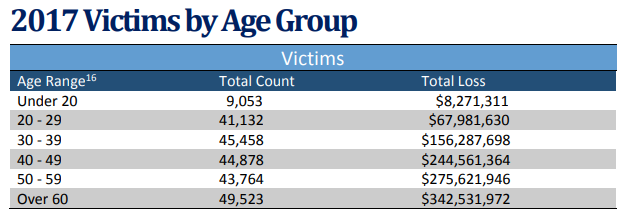
When it comes to demographics, older Americans seem to be more targeted: There were 49,523 complaints from victims over the age of 60 with adjusted losses in excess of $342 million.

Fraud Gets Elaborate

The IC3 also uncovered a few “long-cons” that indicate the lengths to which fraudsters will go to scam their marks. Consider the case of an international investment scheme involving the impersonation of Branch Banking & Trust (BB&T) and JPMorgan Chase executives, the fabrication of U.S. government documents, the creation of fraudulent investment agreements in the name of the banks, and the purchase of luxury vehicles to launder the proceeds of the scheme. It resulted in losses of more than $7 million from victims in more than 20 countries.

In this case, West African operators essentially duped unwitting victims into believing they would receive millions of dollars of investment funding as part of joint ventures with BB&T or Chase. They set about spoofing bank domains and recruiting U.S. citizens to pose as bank “representatives” at in-person meetings with the victims; and fake U.S. government documents were used to convince the victims that the government was sponsoring the investment agreements. The victims were then asked to pay tens of thousands of dollars (often hundreds of thousands of dollars) to U.S.-based bank accounts on the belief that such payments were necessary to effectuate their investment agreements.

The scam was partially broken up by FBI Houston as a result of the mounting number of complaints and forensic data. Only about $200,000 of the cash has been recouped.


Read the Full Article here: >threatpost – The First Stop for Security News

First look at Google Chrome’s UI design refresh

Users of Google Chrome Canary, the cutting edge version of Google’s web browser, have a chance to get a sneak peek of a user interface design refresh that Google may plan to launch in all versions of Chrome eventually.

The feature is hidden behind a flag currently but that is a common practice by Google; the company uses flags to hide future features from the general population. While there is no guarantee that features will land in Chrome one day, it is often the case that Google uses experimental flags to prepare the wider release.

Chrome’s user interface has not changed all that much throughout the years. Google started a Material Design refresh of internal Chrome pages in 2015 and the process is still ongoing. The company changed the design of the Settings page in mid-2017, and the flags page in the end of 2017.

Google Chrome’s UI design refresh

chrome new ui material design

The screenshot above shows the new refreshed Material Design front user interface of Google Chrome. The very first thing you may notice is that Chrome’s tabs are slightly rounded now instead of sharp edged.

Tabs retain the rounded look even if you create a tab overload situation in Chrome when you open too many tabs so that each is displayed without any site indicator (as Chrome does not use scrolling in the tab bar).

The tabbar itself has a white background now. Inactive tabs are displayed with gray text on a gray background, the active tab with gray text on a white background.

There are other changes:

  • The design of the New Tab button changed to a plus icon.
  • The Chrome address bar has round edges, and its background is set to gray and not white anymore.
  • The profile indicator was moved from its original position near the window controls to the main Chrome toolbar.

How to enable the design refresh

chrome design refresh

You need to run Chrome Canary (version 68 or later) on Windows right now to enable the refresh. If the design refresh is not pulled again, it will become available for Mac or Linux as well in the future.

  1. Load chrome://flags/#top-chrome-md in the Chrome’s address bar. The address opens the experimental page of Chrome.
  2. The preference UI Layout for the browser’s top chrome determines the user interface design. Click on the menu next to it and select Refresh.
  3. Restart Google Chrome.

You can undo the change at any time by setting it to the default value. Other values that are supported:

  • Normal — clamshell devices.
  • Hybrid — for devices with touchscreen.
  • Touchable — new unified interface for touch and convertibles.
  • Auto — unclear.

Closing Words

The UI design refresh of Chrome is a work in progress. While it is likely that Google is going to launch a refresh of the design eventually, it is possible that it will look different from the first version that popped up in Chrome Canary in the past days.

Mozilla, maker of Firefox, moved away from rounded tabs with the release of Firefox 57.

Now You: what is your take on the new UI design?

Summary

Article Name

First look at Google Chrome’s UI design refresh

Description

Users of Google Chrome Canary, the cutting edge version of Google’s web browser, have a chance to get a sneak peek of a user interface design refresh that Google may plan to launch in all versions of Chrome eventually.

Author

Martin Brinkmann

Publisher

Ghacks Technology News

Logo


Read the Full Article here: >Top 100 Network Security Tools

Hackers Found Using A New Code Injection Technique to Evade Detection

While performing in-depth analysis of various malware samples, security researchers at Cyberbit found a new code injection technique, dubbed

Early Bird

, being used by at least three different sophisticated malware that helped attackers evade detection.

As its name suggests, Early Bird is a “simple yet powerful” technique that allows attackers to inject malicious code into a legitimate process before its main thread starts, and thereby avoids detection by Windows hook engines used by most anti-malware products.

The

Early Bird

code injection technique “loads the malicious code in a very early stage of thread initialization, before many security products place their hooks—which allows the malware to perform its malicious actions without being detected,” the researchers said.

The technique is similar to the

AtomBombing code injection technique

that does not rely on easy-to-detect API calls, allowing malware to inject code into processes in a manner that no anti-malware tools can detect.

How Early Bird Code Injection Works

Early Bird code injection method relies on a Windows built-in APC (Asynchronous Procedure Calls) function that allows applications to execute code asynchronously in the context of a particular thread.

Here’s a brief step-by-step explanation of how an attacker can inject malicious code into a legitimate process in a way that it gets executed earlier before an anti-malware program starts scanning.

  • Create a suspended process of a legitimate Windows process (e.g., svchost.exe)
  • Allocate memory in that process (svchost.exe) and write the malicious code into the allocated memory region,
  • Queue an asynchronous procedure call (APC) to the main thread of that process (svchost.exe),
  • Since APC can execute a process only when it is in an alertable state, call NtTestAlert function to force kernel into executing the malicious code as soon as the main thread resumes.

According to the researchers, at least three following-mentioned malware were found using Early Bird code injection in the wild.

  • “TurnedUp” backdoor, developed by an Iranian hacking group (APT33)
  • A variant of “Carberp” banking malware
  • “DorkBot” malware

Initially

discovered

by FireEye in September 2017, TurnedUp is a backdoor that is capable of exfiltrating data from the target system, creating reverse shells, taking screenshots as well as gathering system information.

Dates back to 2012,

DorBot

is botnet malware distributed via links on social media, instant messaging apps or infected removable media and is used to steal users’ credentials for online services, including banking services, participate in distributed denial-of-service (DDoS) attacks, send spam and deliver other malware to victims’ computers.

Researchers have also provided a video demonstration, which shows the new Early Bird code injection technique in action.

Read the Full Article here: >The Hacker News [ THN ]

Hackers Found Using A New Code Injection Technique to Evade Detection

While performing in-depth analysis of various malware samples, security researchers at Cyberbit found a new code injection technique, dubbed

Early Bird

, being used by at least three different sophisticated malware that helped attackers evade detection.

As its name suggests, Early Bird is a “simple yet powerful” technique that allows attackers to inject malicious code into a legitimate process before its main thread starts, and thereby avoids detection by Windows hook engines used by most anti-malware products.

The

Early Bird

code injection technique “loads the malicious code in a very early stage of thread initialization, before many security products place their hooks—which allows the malware to perform its malicious actions without being detected,” the researchers said.

The technique is similar to the

AtomBombing code injection technique

that does not rely on easy-to-detect API calls, allowing malware to inject code into processes in a manner that no anti-malware tools can detect.

How Early Bird Code Injection Works

Early Bird code injection method relies on a Windows built-in APC (Asynchronous Procedure Calls) function that allows applications to execute code asynchronously in the context of a particular thread.

Here’s a brief step-by-step explanation of how an attacker can inject malicious code into a legitimate process in a way that it gets executed earlier before an anti-malware program starts scanning.

  • Create a suspended process of a legitimate Windows process (e.g., svchost.exe)
  • Allocate memory in that process (svchost.exe) and write the malicious code into the allocated memory region,
  • Queue an asynchronous procedure call (APC) to the main thread of that process (svchost.exe),
  • Since APC can execute a process only when it is in an alertable state, call NtTestAlert function to force kernel into executing the malicious code as soon as the main thread resumes.

According to the researchers, at least three following-mentioned malware were found using Early Bird code injection in the wild.

  • “TurnedUp” backdoor, developed by an Iranian hacking group (APT33)
  • A variant of “Carberp” banking malware
  • “DorkBot” malware

Initially

discovered

by FireEye in September 2017, TurnedUp is a backdoor that is capable of exfiltrating data from the target system, creating reverse shells, taking screenshots as well as gathering system information.

Dates back to 2012,

DorBot

is botnet malware distributed via links on social media, instant messaging apps or infected removable media and is used to steal users’ credentials for online services, including banking services, participate in distributed denial-of-service (DDoS) attacks, send spam and deliver other malware to victims’ computers.

Researchers have also provided a video demonstration, which shows the new Early Bird code injection technique in action.

Read the Full Article here: >The Hacker News [ THN ]

Portspoof – Spoof All Ports Open & Emulate Valid Services

The primary goal of the Portspoof program is to enhance your system security through a set of new camouflage techniques which spoof all ports open and also emulate valid services on every port. As a result, any attackers port scan results will become fairly meaningless and will require hours of effort to accurately identify which ports have real services on and which do not.

Portspoof - Spoof All Ports Open & Emulate Valid Services

The tool is meant to be a lightweight, fast, portable and secure addition to any firewall system or security system. The general goal of the program is to make the reconnaissance phase as slow and bothersome for your attackers as possible. This is quite a change to the standard 5s Nmap scan, that will give a full view of your systems running services.


Techniques Used by Portspoof

All configured TCP ports are always open

Instead of informing an attacker that a particular port is in a CLOSED or FILTERED state a system running Portspoof will return SYN+ACK for every connection attempt, spoof all ports open.

Result: As a result it is impractical to use stealth (SYN, ACK, etc.) port scanning against your system, since all ports are always reported as OPEN. With this approach it is really difficult to determine if a valid software is listening on a particular port.

Every open TCP port emulates a valid services

Portspoof has a huge dynamic service signature database, that will be used to generate responses to your offenders scanning software service probes.

Scanning software usually tries to determine a service that is running on an open port. This step is mandatory if one would want to identify port numbers on which you are running your services on a system behind the spoofed ports. For this reason, Portspoof will respond to every service probe with a valid service signature, that is dynamically generated based on a service signature regular expression database.

Result: As a result an attacker will not be able to determine which port numbers your system is truly using.

Portspoof Port Spoofing Tool Features

The most important features that Portspoof has:

  • Portspoof is a userland software and does not require root privilege
  • Binds to just one TCP port per a running instance
  • Easily customizable through your iptables rules
  • Marginal CPU/memory usage (multithreaded)
  • More than 9000 dynamic service signatures are supported

If you choose to, Portspoof can be used as an ‘Exploitation Framework Frontend’, that turns your system into a responsive and aggressive machine. This means exploiting your attackers’ tools and exploits in response to a port scan.

You can download Portspoof here:

portspoof-v1.3.zip

Or read more here.

Read the Full Article here: >Darknet – The Darkside